About the Platform
BACKGROUND
The Arab region faces numerous natural and man-made hazards, often intensified by climate change. Over the past 50 years, the region has experienced significant economic losses, totalling nearly $60 billion, with droughts having the largest impact, particularly in countries like Iraq, Morocco, Syria, Jordan, and Somalia. Droughts have led to decreased agricultural productivity and biodiversity, severely affecting rural communities. Other challenges include sand encroachment, damaging infrastructure and reducing crop yields, and wildfires, especially in Mediterranean countries.
In 2023, the region, already vulnerable to climate change, saw several catastrophic events. Earthquakes in Turkey, Syria, and Morocco resulted in massive loss of life and billions in economic damages. Libya was devastated by Storm Daniel, leading to dam collapses and widespread destruction.
The Sendai Framework
The Sendai Framework for Disaster Risk Reduction 2015-2030 addresses natural and man-made hazards, including biological, environmental, technological, and marine hazards and risks, emphasizing a whole-society approach to reducing risk and building resilience. It focuses on preventing the creation of new risks, reducing existing risks, and strengthening resilience through preparedness and recovery. This approach requires a shift from traditional disaster management to holistic, risk-resilient development, supported by regional and international cooperation.
The Sendai Framework is integral to achieving the Sustainable Development Goals (SDGs), as it highlights the importance of disaster risk reduction across multiple sectors. To achieve sustainable development, member countries must implement the Sendai Framework at all levels, engaging stakeholders in risk-informed development planning and promoting disaster risk management across various sectors.
Regional Platforms for Disaster Risk Reduction
Regional platforms bring together governments and stakeholders to enhance political commitment to disaster risk reduction, identify priorities, assess progress, and strengthen partnerships. These platforms promote the sharing of good practices, knowledge, and the integration of disaster risk reduction across sectors, including development and climate issues. They foster an inclusive, multi-stakeholder approach at the regional level, such as through the Arab Partnership for Disaster Risk Reduction.
The Sendai Framework recognizes Global and Regional Platforms as key mediums for its implementation. These platforms serve as dynamic forums where policymakers, experts, and practitioners can announce initiatives, share information, and monitor progress. They play a crucial role in forging partnerships, assessing progress, and promoting disaster risk management integration across all sectors, contributing to the broader UN conference and summit follow-up processes.
Arab Platforms for Disaster Risk Reduction
Arab regional platforms and conferences began during the Hyogo Framework for Action (2005-2015), providing a forum for governments and stakeholders to reaffirm their commitment to disaster risk reduction and share successful practices. To effectively implement the Sendai Framework and the Arab Strategy for DRR, UNDRR's Regional Office for Arab States has convened multi-stakeholder platforms that bring together Arab Member States, intergovernmental organizations, NGOs, academia, civil society, and UN organizations. These platforms align the implementation of the Arab DRR Strategy 2030, enhance DRR efforts, and provide a unique opportunity for Arab countries to reaffirm their political commitment.
To prepare for the Arab Regional Platforms, two Arab Regional Partnership Meetings for DRR are held annually to establish the agenda and define the main thematic sessions.
Key past platforms include:
- Aqaba 2013: Focused on local governments' roles in implementing the Hyogo Framework, resulting in the Aqaba Declaration on DRR in Arab Cities.
- Sharm El Sheikh 2014: Focused on the region's contributions to the Sendai Framework, adopting the Sharm El Sheikh Declaration on DRR.
- Doha 2017: Updated the Arab Strategy for DRR 2030, resulting in the Doha Declaration at the 5th Global Platform for DRR.
- Tunisia 2018: Developed a Prioritized Action Plan 2018-2020 for the Sendai Framework and issued the Tunis Declaration on DRR.
- Rabat 2021: Focused on accelerating domestic DRR action, resulting in the Prioritized Action Plan for DRR 2021-2024 and the Rabat Declaration on DRR.
SIXTH ARAB REGIONAL PLATFORM FOR DISASTER RISK REDUCTION
Overview
Following the success of the Fifth Arab Regional Platform for DRR and the outcomes of the 2022 Global Platform for DRR, the Sixth Arab Regional Platform will be hosted by the Government of Kuwait and co-organized by UNDRR Regional Office for Arab States and the League of Arab States in February 2025. This event aims to build on ongoing political and technical dialogues to enhance disaster risk reduction in the region.
Objectives
The Platform will gather various stakeholders to:
- Assess progress in implementing the Sendai Framework and the Arab Strategy for DRR 2030.
- Set regional priorities and identify approaches to advance disaster risk reduction.
- Exchange knowledge and best practices to foster resilient economies and sustainable development.
- Provide recommendations for the 2025 Global Platform for DRR.
- Integrate DRR with climate change and sustainable development agendas.
Agenda Highlights
- Opening and closing ceremonies
- Sessions dedicated to countries’ official statements.
- Ministerial session for approving final documents
- Plenary and thematic sessions focusing on the Sendai Framework’s priorities
- Special sessions and side events organized by partners
- Exhibition on Disaster Risk Reduction (Marketplace)
Expected Outcomes
- A political declaration (Kuwait Declaration) affirming the region’s commitment to the Sendai Framework and Arab Strategy for DRR.
- Voluntary action statements from DRR stakeholders.
- A Prioritized Action Plan for DRR (2025-2027) for the Arab region.
Theme
"Building Resilient Arab Communities: From Understanding to Action." This theme emphasizes the journey from understanding disaster risks to taking concrete actions to build resilience. It highlights the importance of risk management, governance, investment, and innovation, and it promotes the integration of DRR into development and climate policies.
Conference Structure
- First Segment: Pre-platform consultations on key topics and themes, stakeholder commitments, Prioritized Action Plan, and finalizing the Kuwait Declaration.
- Second Segment: A three-day in-person conference including plenaries, thematic sessions, special sessions, side events, and a marketplace exhibition. A fourth day dedicated to Ministerial meeting to adopt outcomes and conclude the conference.
Participation
This Ministerial-level event will welcome around 500-600 participants from Arab countries, including representatives from governments, civil society, UN organizations, the private sector, academia, and media.
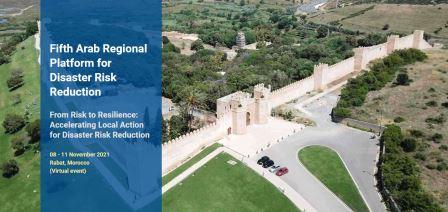
The 5th Arab Regional Platform for DRR, hosted by the Kingdom of Morocco, was held online in November 2021, prioritizing the safety of participants due to the pandemic.
Africa-Arab Platform on DRR, hosted by Tunisia in October 2018, under the theme "Towards disaster risk informed and inclusive sustainable development."